Ross Sea Environmental Awareness Manual (1st Edition 2025)
The Ross Sea Environmental Awareness Manual (RS-EAM) is a field guide to the Ross Sea region of Antarctica, extending over 1700 km from the Balleny Islands in the north to Starshot Glacier in the south. The manual has 172 maps and 62 photographs and a wide range of information on stations and facilities, protected areas, Important Bird Areas, Historic Sites and Monuments, sites with Visitor Site Guidelines, and sensitive sites. The maps show the locations of breeding wildlife (penguins, petrels, seals), physical features, scientific stations, and protected sites in the Ross Sea region. Photographs illustrate local wildlife species and frequently visited sites.
The manual was jointly commissioned by the National Antarctic Programs of Germany, Italy, New Zealand, South Korea and the United States. However, the manual should be of interest to all visitors to the Ross Sea. The 186-page manual is available for free download (link below).
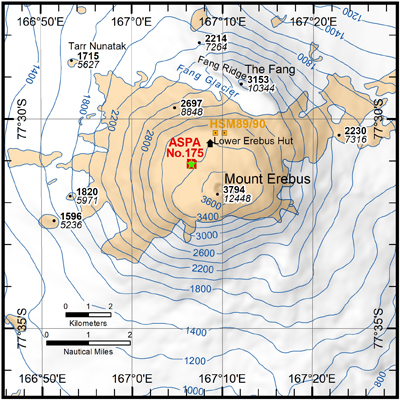
Example map of Mount Erebus, Ross Island
The region of Antarctica covered by this manual is changing rapidly as a result of climate change. As a result, even as this manual is published we know that some aspects – such as ice coastlines – will already be out of date. Wildlife populations are constantly fluctuating and even though breeding localities for many species tend to persist over time, there is also evidence that populations are shifting in response to environmental drivers, with changes in sea ice being especially influential. In addition, regulations such as protected areas and Visitor Site Guidelines may also change from year to year.
The Ross Sea EAM is therefore a guide to a dynamic environment, and it should not be assumed that because wildlife, vegetation or other sensitive features are not identified in this publication they are not present in the field. Moreover, only wildlife species for which data on breeding sites are available and philopatric species – those that breed in the same localities each year – have been included.
It is recommended that visitors exercise caution at all times when operating in the region, and reliance should be made on prudent judgement gained from experience and information from other sources, as well as that provided in this manual. We hope the Ross Sea EAM will help people protect this most remarkable region so it can be used wisely for science and other peaceful purposes in accordance with the Antarctic Treaty and its Environmental Protocol.
Digital download of Ross Sea Environmental Awareness Manual
The Manual is published in digital pdf form, with a limited number of hard copies made available for National Programs.
Download the digital pdf version of the Ross Sea Environmental Awareness Manual (1st Edition) (15 MB pdf).
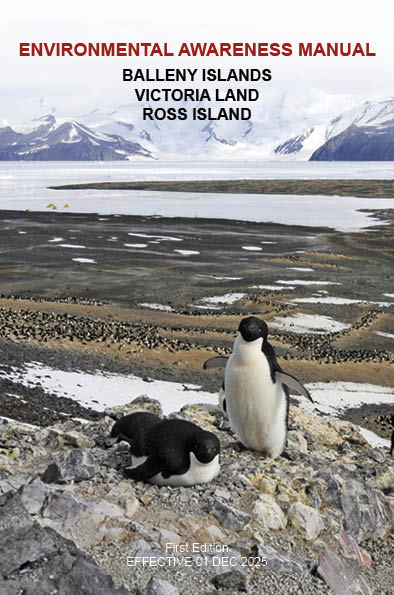
Ross Sea Environmental Awareness Manual cover: Adélie penguins, Seabee Hook, Cape Hallett; © Colin Harris 2010
EAM design & background
The first Wildlife Awareness Manual (WAM) was designed as an aid for helicopter pilots operating in the Antarctic Peninsula region. Flight operations have potential to cause wildlife disturbance. Helicopters typically operate at lower elevations than fixed-wing aircraft and also have greater flexibility in where they can land, elevating the risk of potential interactions with wildlife. The manual was therefore modelled on a Helicopter Landing Site manual in routine use by the Royal Air Force in the United Kingdom, even though that manual was not designed around wildlife awareness.
The Antarctic Peninsula manual was found to be effective in the field by national program operators, and has come to be used by scientific expeditions and tour operators. The Ross Sea Environmental Awareness Manual has therefore adopted the same general format, although the range of information included and detail in supporting maps has been substantially enhanced.
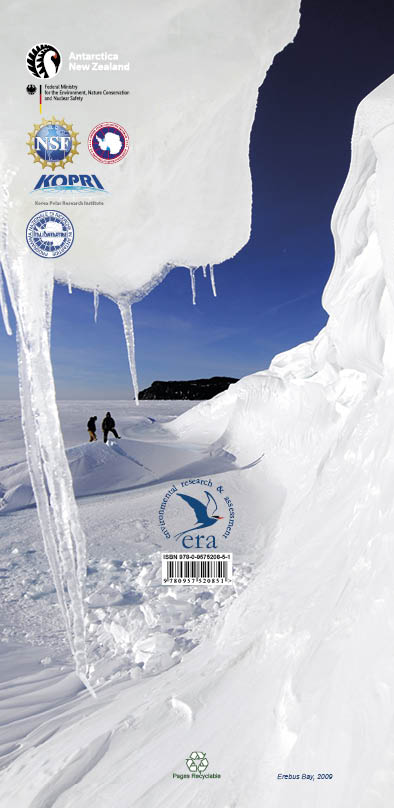
The back cover. Photo: © Colin Harris 2012.